
TIME TO CHANGE THE WAY WE THINK ABOUT VIETNAM
An Indo-Pacific strategic partner in a ruptured world, not just food and “boat people”
By Julie Nguyen
September 23, 2026
Canadians have had a wake-up call over the last two years as United States-imposed tariffs have shaken up our world. Toronto, with its large population of Vietnamese Canadians, needs to change the way we think about Vietnam. The world has changed, and for the sake of Canada’s future prosperity, we cannot afford to be stuck in the old thinking of the Cold War.
A quick search for “Vietnam” in major Canadian newspapers will show that there are very few articles beyond the mention of Vietnamese food, notably banh mi and pho, and stories about the plight of Vietnamese refugees, the so-called “boat people” who arrived in Canada.
Vietnam was once an adversary of the U.S. during the Vietnam War from 1955 to 1975. But that was not the case with Canada.
Since then, the U.S. has thawed its Cold War attitude towards Vietnam with the Comprehensive Strategic Partnership in 2023, covering issues such as trade, technology, defence, security and education. It is the highest bilateral partnership Vietnam has with any other country.
Meanwhile, Canada signed the Comprehensive Partnership with Vietnam in 2017, covering political and diplomatic relations, trade and investment, defence and security, science and technology, education and people-to-people ties. This bilateral partnership is expected to be upgraded when Vietnamese President Tô Lâm makes an official visit to Ottawa on September 24.
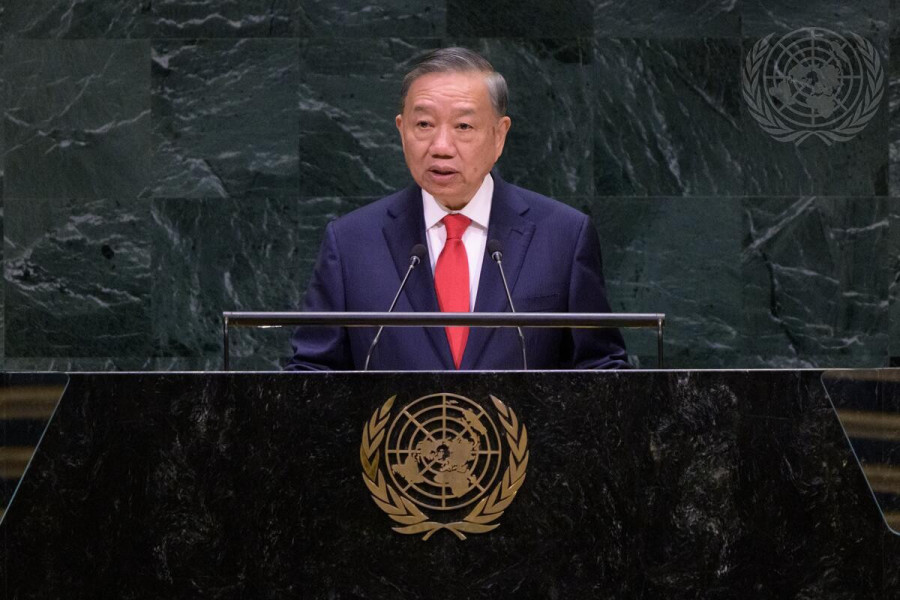
President Tô Lâm Addresses United Nations General Debate, 81st Session, Sept. 22, 2026. Photo: VNA
Canada is home to over 275,000 Vietnamese Canadians, with more than 82,000 living in the Greater Toronto Area, and 42,000 residing in the city of Toronto alone.
Understandably, the so-called Vietnamese “boat people” arrived in Canada during a difficult time, mostly from 1975 to 1980, and any hardened attitudes against Vietnam should be understood through the context of their personal experiences. In Canada, organizations representing the so-called Vietnamese “boat people,” established during that humanitarian crisis, remain staunchly opposed to closer relations with Vietnam, let alone serving as a bridge for Canadian trade and investment.
But much time has passed.
The majority of Vietnamese Canadians today are not the so-called “boat people.” They are from families of economic immigrants, arriving by plane since the 1990s as business owners, skilled workers and international students. Many of them realize the potential benefits of staying connected with the country of their birth. Canadians should realize this too.
With a population of over 100 million, Vietnam is Canada’s largest trading partner among the 11-member Association of Southeast Asian Nations (ASEAN) and Canada’s sixth-largest trading partner in the Indo-Pacific.
In 2024, two-way merchandise trade between Canada and Vietnam reached $15.7 billion. But the bilateral trade flow is striking. Canada imported $14.7 billion worth of merchandise from Vietnam while exporting only about $1 billion.
That gap presents an opportunity for Canadian companies.
Canada and Vietnam are but two nations among the 12-member Comprehensive and Progressive Agreement for Trans-Pacific Partnership (CPTPP), an international agreement that provides Canadian companies preferential market access to Vietnam and eliminates tariffs on almost all of Canada’s exports, including agricultural and agri-food products, industrial goods, vehicles and automotive parts, and metals and minerals.
But doing business in Asia, especially in Vietnam, requires building a relationship first. And we cannot build a relationship if we are still stuck in the Cold War thinking of the past, an attitude that even the U.S. has abandoned.
Canadian businesses can shed that attitude by connecting with the Asia Pacific Foundation of Canada, a not-for-profit think tank established in 1984 that focuses on Canada’s relationships with Asia. They can also join local Vietnamese Canadian associations that promote Canada-Vietnam trade and investment, security co-operation and people-to-people ties.
Canadians are on the right track by attracting investment, removing interprovincial trade barriers and diversifying our trade partnerships around the world. Changing our thinking about Vietnam and taking the necessary steps to build those bilateral relationships will benefit Canada’s long-term prosperity.
Julie Nguyen is a Director at the Canada Vietnam Society - Toronto Chapter.
 Print
Print